Michigan Debt Relief by the Numbers: 5-Year Debt Trends
From credit cards to mortgages, Americans have quite a bit of debt. Michigan is one of the states where consumers have a somewhat smaller debt burden. The average Michigan resident had $47,000 in debt in 2024, according to the Federal Reserve Bank of New York. That’s $14,700 less than the U.S. average.
Even with lower debt levels, many Michigan residents still struggle with debt. Data from Freedom Debt Relief shows that the number of adults in the state who have looked into debt relief in the last five years has risen rapidly, from 53,512 in 2020 to 93,369 in 2024.
Those debt relief seekers carried an average of $75,066 in unsecured debt in 2024, just slightly below the national average of $76,079 for Americans seeking debt relief. You’ll find more debt statistics from the Great Lakes State below—and advice on how to get free of overwhelming debt.
Michiganders can free up cash each month with Freedom Debt Relief

Ozzy S., Freedom client²
“Right away, I had more money each month because of program costs so much less than what I was paying on my minimums.”

Excellent •
5-Year Debt Trends in Michigan
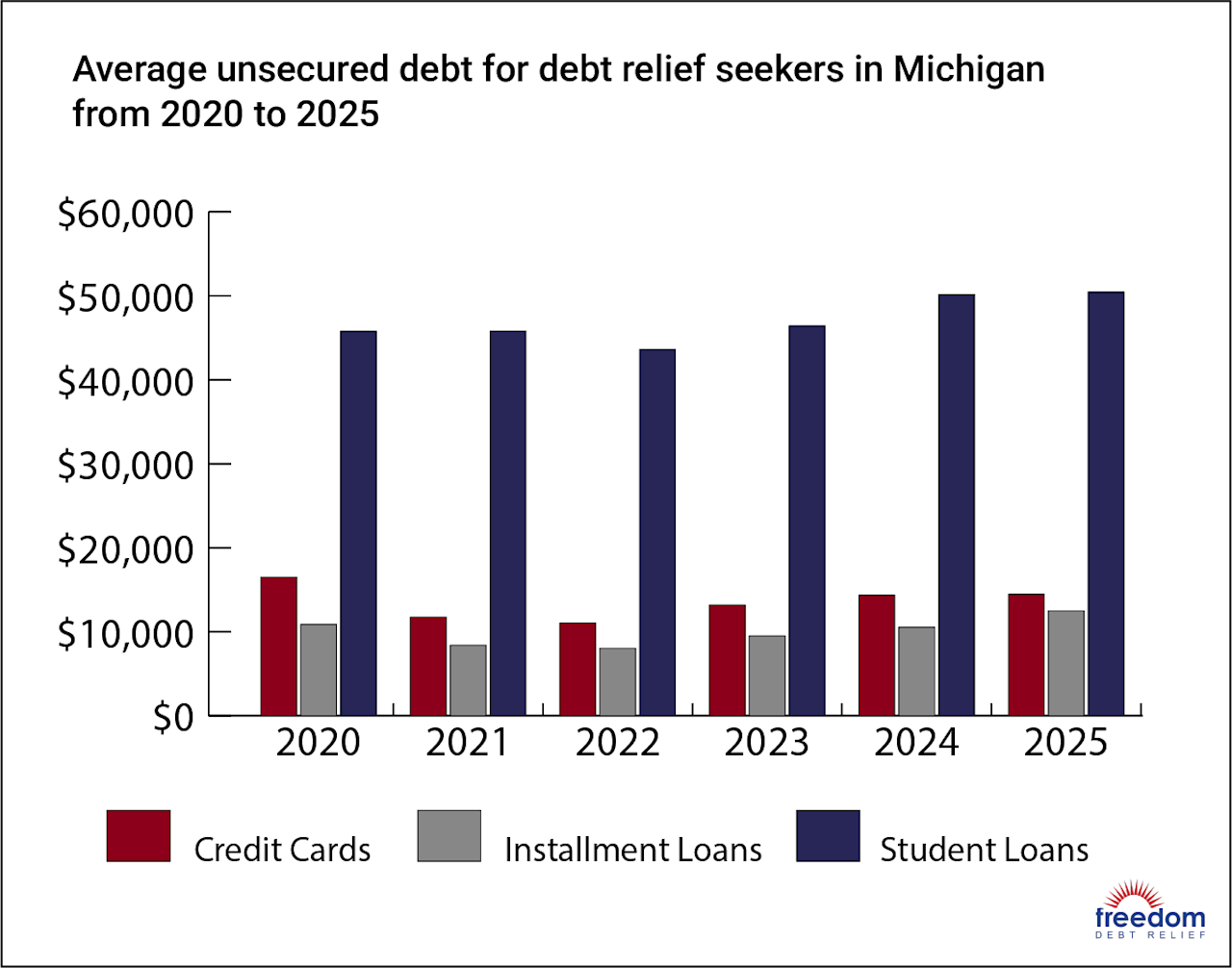
Consumer debt has declined and then climbed up again since the start of the decade, in Michigan and the rest of the U.S. Michigan debt relief seekers had an average of $73,189 in unsecured debt in 2020. The average balance dropped to $62,691 in 2022 before going back up to $75,066 in 2024. That’s a 3% increase in unsecured debt, which includes credit card debt, personal loans, and other types of debt without any collateral.
Among U.S. debt relief seekers, the average amount of unsecured debt increased 10% from $69,323 in 2020 to $76,079 in 2024. Michigan has had much less growth in this type of debt.
Monthly debt payments are also less of a burden in Michigan than nationwide. In 2024, Michigan debt relief seekers had an average of $1,514 in monthly debt payments and a 34% debt-to-income (DTI) ratio. That means a little over one-third of their income goes toward debt.
The average monthly debt payment for debt relief seekers nationwide was $1,717 in 2024, with an average DTI ratio of 38%. Debt doesn’t cost Michigan residents as much of their income, at least compared to the average American looking into debt relief.
Michigan credit card debt
Debt relief seekers in Michigan had an average of $14,366 in credit card debt with a $465 monthly payment in 2024. Those numbers are better than the U.S. average for people seeking debt relief. The average credit card debt nationwide for consumers interested in debt relief is $15,636 with a monthly payment of $487.
Credit cards can be dangerous if you overspend or fall behind on your payments. These are common issues for Michigan debt relief seekers, who had an average of 7.5 credit cards and 78% credit utilization in 2024. That means their credit card balances take up 78% of their credit limits on average. They also had an average of $4,817 in past-due balances.
High credit card balances are even more of an issue for consumers with low credit scores. Michigan debt relief seekers with poor credit (a score below 580) had average credit utilization of 95%, close to maxing out their cards. If you’re in a similar situation, it could be time to look into how to get credit card debt relief.
Michigan auto loan debt
Michigan debt relief seekers had an average car payment of $640 on an average auto loan balance of $22,021 in 2024. Both numbers are below the national average for debt relief seekers (a $726 car payment on a $26,839 auto loan balance). But auto loan debt has increased significantly over the last five years. In 2020, Michigan debt relief seekers had an average car payment of $516 and an average auto loan balance of $16,572.
Michigan mortgage debt
Housing is more affordable in Michigan than in the country as a whole. Michigan homeowners have a median mortgage payment of $1,573 compared to the U.S. median of $2,035.
Debt relief seekers in Michigan pay even less on average. Their average mortgage payment was $1,424 per month, and they had an average mortgage balance of $165,126 in 2024. The average American interested in debt relief that same year paid $1,949 a month and had $241,535 on their mortgage, a difference of $76,409.
Michigan installment loan debt
Michigan residents looking for debt relief had an average monthly payment of $401 on average installment loan debt of $10,544 in 2024. Both amounts are very close to the average for U.S. residents seeking debt relief, which is a monthly payment of $436 on installment loan debt of $10,582.
This type of debt was decreasing for a couple of years. The average balance for Michigan debt relief seekers got as low as $8,039 in 2022. It has rebounded since then and reached an average of $12,487 over the first half of 2025. The recent growth in loan balances could be a sign that more consumers are using personal loans to consolidate debt.
Michigan student loan debt
Higher education usually isn’t cheap, and it’s even more expensive in Michigan. Four years at a public university in Michigan costs 18% more than the national average, according to the Education Data Initiative.
With that in mind, it’s no surprise that student loan debt is higher in this state than nationwide. The average debt relief seeker in Michigan had 5.9 student loans and $50,156 in balances in 2024. In the entire U.S., the average student loan balance for debt relief seekers was a little lower at $49,861.
Student loans often have low monthly payments. Michigan debt relief seekers only had to pay an average of $287 per month on their student loans in 2024. While this puts less pressure on your budget, you could be in debt for a long time if you only pay the minimum on your student loans.
Michigan Debt Delinquencies and Collections
Consumers in Michigan tend to do well at staying on top of debt payments. Michigan’s debt delinquency rates are lower than the national average for auto loans, bankcards (credit cards), and mortgages. This means Michigan residents are less likely to be delinquent on those accounts.
The table below provides delinquency rates for Michigan auto loans, credit cards, and mortgages, according to TransUnion data from September 2025. Delinquency rates are measured by the percentage of people with each type of debt that are at least 30, 60, and 90 days past due (DPD).
| Type of debt | 30+ DPD | 60+ DPD | 90+ DPD |
|---|---|---|---|
| Auto loan | 3.64% | 1.43% | N/A |
| Credit card | 4.47% | 3.11% | 2.25% |
| Mortgage | 2.87% | 1.23% | 0.70% |
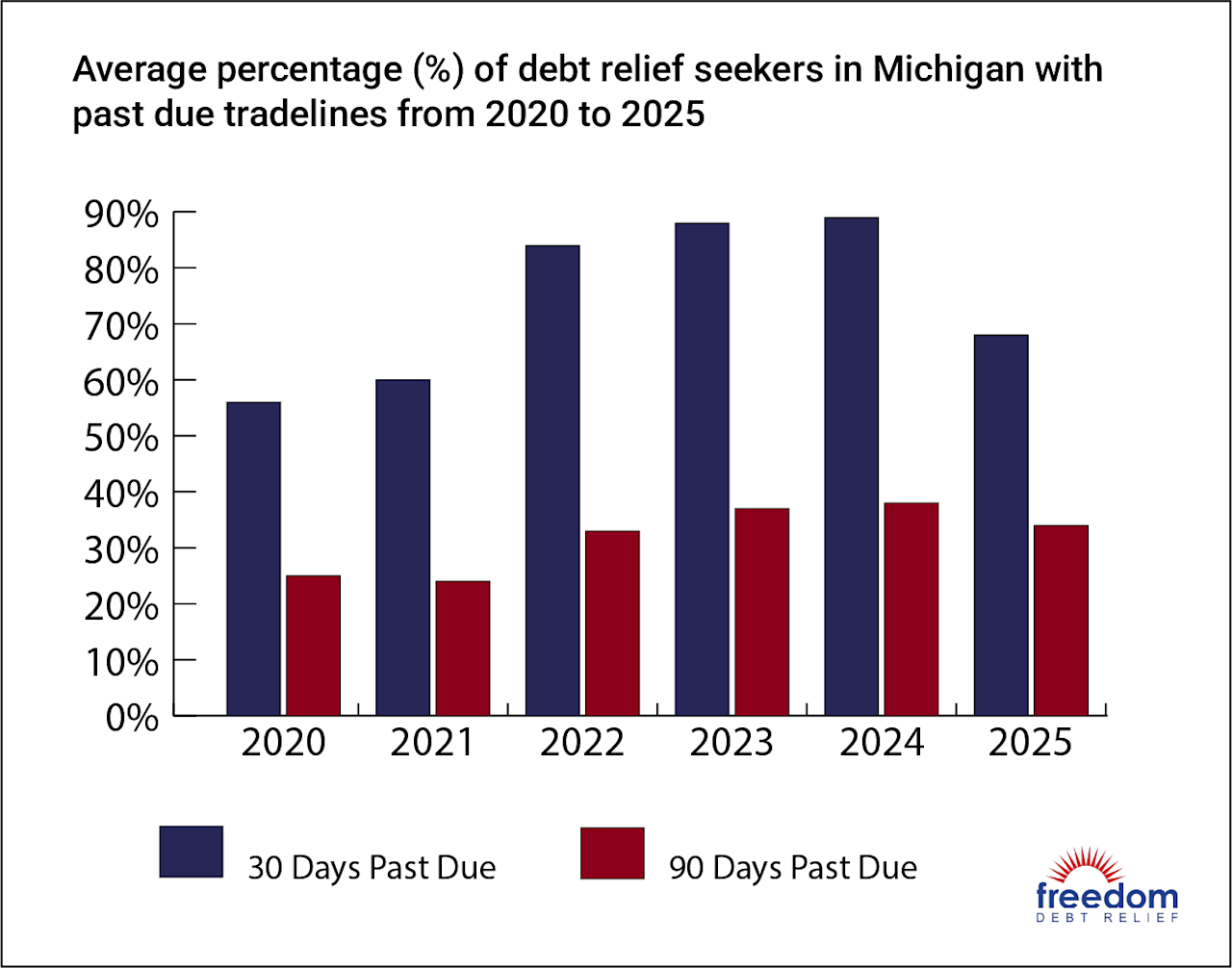
On the other hand, most Michigan debt relief seekers have fallen behind on their debt. In 2024, 89% of Michigan residents looking at debt relief had an account at least 30 DPD, and 38% had an account at least 90 DPD. Those numbers are higher than the national averages for debt relief seekers: 82% have an account at least 30 DPD and 35% have an account at least 90 DPD.
Collections accounts are also common. The average collections balance (among Michigan debt relief seekers with accounts in collections) was $2,497 in 2024. But that’s less than the national average of $3,183 for debt relief seekers across the country.
Where can I find free credit counseling services in Michigan for debt help?
It can be hard to find free credit counseling services in Michigan. Most agencies offer credit counseling as part of a debt management plan, which costs $20 to $40 per month. But you can apply for a fee waiver if you can’t afford it.
GreenPath offers free credit counseling in Michigan without being enrolled in a debt management plan.
Many Michigan credit unions also offer free credit or financial counseling services for their members. Another option is visiting a Financial Empowerment Center (FEC) in your area. FECs offer free financial counseling to residents of the city or county where they’re located.
Credit counseling services vary depending on the organization offering them. Some organizations offer help with budgeting, debt consolidation, and other debt repayment methods. Others focus on debt management plans (DMPs), meaning they set up a three- to five-year payment plan with your creditors. You may want to contact a few organizations to find out which services they offer and pick the one that best fits your needs.
Michigan Statute of Limitations
The statute of limitations in Michigan is the time limit on suing you for a debt. An account that is past the statute of limitations is known as time-barred debt. If you’re sued for a time-barred debt, you could go to court and ask the judge to throw out the lawsuit.
Statute of limitations laws vary depending on the state and the type of debt contract you have. In Michigan, the statute of limitations on most debts is six years.
| Type of debt contract | Michigan statute of limitations |
|---|---|
| Written contracts | 6 years |
| Oral contracts | 6 years |
| Promissory notes | 6 years |
| Open-ended accounts (such as credit cards) | 6 years |
What are the Michigan debt collection laws?
Michigan has two debt collection laws similar to the Fair Debt Collection Practices Act (FDCPA). Under Michigan state law, creditors and debt collectors can’t:
Make deceptive, false, or misleading statements
Call at unusual hours, including before 8 a.m. and after 9 p.m., unless you’ve agreed to it in writing
Harass, threaten, or use abusive language
Tell your employer about a debt you allegedly owe
Tell you that you’re going to be arrested
Michigan debt collection laws apply to creditors and third-party debt collectors. That’s an important difference from the FDCPA, which only applies to debt collectors and not creditors.
Reviews and Testimonials from Michigan
My experience has been successful with freedom debt relief and how quickly and affordable they get these settlement handled
David, US
Very nice and profession
Lena Khatchikian, US
Very supportive staff Answering all my questions in a timely manner Lets me know what is going on at all times Responds quickly Extremely helpful Very concerned with your financial health I give them a 10 out of 10 Negotiates great deals
Paul Erwin, US
Michigan Debt Relief
Large amounts of debt can be hard to manage, especially when it’s high-interest debt, like credit cards. If you can’t afford to repay your debt, you may want to consider a Michigan debt relief program. With this type of program, you make one low monthly deposit into a debt settlement account. The debt relief company negotiates settlement offers with creditors and debt collectors for you.
A debt relief program could be the best way to deal with your debt. In 2025, Freedom Debt Relief clients enrolled an average of $22,730 in debt.
Debt relief in Michigan starts with a free debt evaluation where you talk about your current financial situation. If you’re eligible, a Debt Consultant will then make a debt relief plan based on your income and expenses. It’s possible to complete the Freedom Debt Relief program in as little as 24 to 48 months.
Are there state-funded debt relief programs available in Michigan?
No, Michigan doesn’t have state-funded debt relief programs. If you’re looking for debt relief in Michigan, consider a program with a private debt relief company. Freedom Debt Relief operates in Michigan and has served more than 1 million clients nationwide.
Not all debt relief companies are legitimate, and there are some common red flags to watch out for. Avoid debt relief companies that do any of the following:
Charge upfront fees
Guarantee results, such as getting rid of your debt for pennies on the dollar
Claim to be part of a government- or state-sponsored program
Try to get you to enroll in a program before providing a free debt evaluation
Is Debt Consolidation the Best Debt Solution?
Debt consolidation in Michigan is a popular repayment strategy that has helped many consumers pay off their debts. For this strategy, you get a debt consolidation loan with a fixed monthly payment. It should also have a lower interest rate than your other accounts.
A lower interest rate could help you save money as you get rid of debt. Another benefit of a debt consolidation loan is that it provides a structured plan with a fixed end date. If you get a three-year debt consolidation loan and you make all the required payments, then you could be done paying it off in three years.
If you’re not sure whether debt consolidation is right for you, here are some other debt repayment methods:
DIY debt payoff is when you set up your own repayment plan. If you can afford your debt payments, the DIY approach could be the simplest option.
Debt settlement is when you negotiate with creditors or debt collectors to resolve your debts for less than the full amount. You could settle debts yourself or with the help of a debt relief company. If you can’t pay back your debts, a debt settlement may be the solution.
A debt management plan (DMP) is a full payment plan that typically lasts between three and five years. You’ll need to work with a credit counseling agency, which can set up a DMP with your creditors for you.
Bankruptcy is a legal process to discharge debt. Chapter 7 bankruptcy may require that you give up some of the things you own, while Chapter 13 bankruptcy involves a three- to five-year payment plan. After you meet the requirements, any remaining debt you have is discharged.
What are the pros and cons of debt consolidation for someone living in Michigan?
Debt consolidation has several valuable benefits for Michigan residents:
You have fewer monthly payments. If you consolidate all your debt, you’ll only have one monthly debt payment to make going forward. It’s a lot easier to manage and reduces your risk of a missed payment.
You could get a lower interest rate. For example, debt consolidation loans often have lower interest rates than credit cards. If you secure a lower rate on your debt, you could save money overall.
You could have a fixed payment and payoff timeline. Credit cards typically have small minimum payments and no set end date. Debt consolidation loans normally have fixed monthly payments and a set term.
While debt consolidation in Michigan could be a smart move, there are potential drawbacks:
You may need to pay extra fees. Loans may have origination fees, and most balance transfer cards charge a balance transfer fee.
It’s harder to consolidate debt with a low credit score. You could do it, but you’ll have fewer options and might need to pay a high interest rate.
Debt consolidation doesn’t fix the cause of your debt. You’re only restructuring debt when you consolidate, not addressing the root cause. For example, if you overspend on credit cards, that’s an issue you’d need to work on whether you consolidate debt or not.
What credit score is needed for a debt consolidation loan in Michigan as of December 2025?
The credit score needed for a debt consolidation loan in Michigan depends on the lender. Some lenders have a minimum credit score of 550 or 600. Other lenders don’t have a minimum credit score requirement for debt consolidation loans. It’s harder to get a debt consolidation loan with poor credit, but it’s not impossible.
You can sometimes find a lender’s minimum credit score requirements on its website. Or you could ask if the lender has a pre-approval tool. Most lenders let you check if you’re pre-approved for a loan online. This is a good way to find out if you’re likely to qualify for a loan and what kind of terms you could expect.
What impact does debt consolidation have on credit scores for Michigan residents?
Michigan residents may notice a small drop in their credit scores immediately after debt consolidation. Those who use debt consolidation to get rid of debt could eventually end up with much higher credit scores.
Debt consolidation could affect your credit in several ways. When you apply for a debt consolidation loan, the lender pulls your credit, which puts a hard inquiry on your credit file. A hard inquiry has a minor impact on your credit score. Most people’s scores drop by fewer than five points from a hard inquiry.
A debt consolidation loan could improve your credit mix, another factor in your credit score. If you previously had only credit cards, then getting a loan will diversify the types of credit you have. A more diverse credit mix is typically good for a person’s credit score.
When you pay off credit cards with a debt consolidation loan, that lowers your credit utilization. Credit utilization is the portion of your credit limit that you use. If you avoid running up balances on those cards again, debt consolidation could lead to a big improvement in your credit utilization.
Michiganders can free up cash each month with Freedom Debt Relief
Ozzy S., Freedom client²
“Right away, I had more money each month because of program costs so much less than what I was paying on my minimums.”
Excellent •
What are the main types of debt consolidation options available to Michigan residents?
The main types of debt consolidation available to Michigan residents are debt consolidation loans, balance transfer cards, and home equity lines of credit (HELOCs) or loans. Here are more details on each option:
A debt consolidation loan is a personal loan used to pay off debt. This type of loan has a fixed monthly payment, interest rate, and term. Personal loans have lower interest rates than credit cards, on average. But your loan’s rate will depend on several factors, including your credit score.
A balance transfer card is a credit card that allows transfers of other debts. Balance transfer cards normally have a low introductory interest rate—the best cards start off with a 0% introductory rate. After the intro period, often as long as 21 months, the interest rate increases quite a bit.
A HELOC and a home equity loan are both ways of borrowing against your home. If you have home equity, meaning your home is worth more than what you owe on it, you could use that to get a loan or a line of credit. Because the loan is secured by the home, home equity loans and HELOCS often have low interest rates compared to other kinds of loans. But if you don’t repay the loan, you could lose your home.
Are there specific Michigan laws protecting consumers in debt consolidation programs?
Michigan doesn’t have consumer protection laws specifically for people in debt consolidation programs. However, the state has consumer protection laws that creditors and debt collectors must follow. Michigan’s laws prohibit creditors and debt collectors from:
Providing false or misleading information
Harassing, threatening, or abusing consumers
Calling at inconvenient hours, generally considered before 8 a.m. or after 9 p.m., unless the consumer agrees to it in writing
Talking to a consumer’s employer about an alleged debt
Telling consumers they’re going to be arrested over a debt
The protections in these laws are very similar to those of the Fair Debt Collection Practices Act (FDCPA). A key difference is that the FDCPA is only for third-party debt collectors, not creditors. Michigan’s laws are for creditors—the original company that issued a debt—as well as third-party debt collectors.
How can I find reputable debt consolidation companies in Michigan?
To find reputable debt consolidation companies in Michigan, search online for lenders that offer debt consolidation loans. Select a few lenders that offer loans for people in your credit score range. Then, read reviews for the lenders you chose. You can usually find lender reviews on personal finance websites and forums.
You could consolidate debt with any company that has debt consolidation loans, including online lenders, national banks, and local credit unions. If you want a lender with an office you can visit, find out which companies have branches in your area.
Your current bank or credit union could be a good place to start, if they offer debt consolidation loans. You’re already a client, and the place where you do your banking understands your financial situation, which could make the application process easier.
What are current interest rates for debt consolidation loans in Michigan March 2026?
Interest rates for debt consolidation loans in Michigan generally range from about 7% to 36%. The lender and the borrower’s credit score are normally the most important factors influencing the loan’s interest rate.
Some lenders offer lower interest rates than others. It’s almost always a good idea to go rate shopping and compare lender options before you apply for a loan. You could pull pre-approval offers from debt consolidation loan companies, banks, and local credit unions to find out who offers you the best deal.
In most cases, lenders reserve their lowest rates for borrowers with good or excellent credit. They charge higher rates to borrowers with poor credit or average credit because there’s more risk involved. If you have good credit when you apply for a debt consolidation loan, that could help you qualify for a lower rate.
How does a debt management plan in Michigan differ from a consolidation loan?
Nonprofit credit counseling agencies offer a service called a debt management plan (DMP). The agency sets up a payment plan with your creditors. A DMP lasts three to five years, and during that time, you make one monthly payment to a dedicated account you control. The credit counseling agency makes sure each payment is distributed to your creditors.
A consolidation loan is issued by a lender or financial institution. You apply for a consolidation loan, and if you’re approved, you use the loan to pay off your debts. You then make one monthly payment on your consolidation loan until it’s repaid.
DMPs and consolidation loans could both get you down to a single monthly payment. They also provide a structured plan to pay off your debt. With each method, you have a fixed payment and end date.
The main difference is that you can get a consolidation loan on your own, but you need a credit counseling agency for a DMP. You also have more control with a consolidation loan. You can shop around for lenders and choose a longer term if you’d like a cheaper monthly payment or a shorter term if you’d like to pay off your debt more quickly. Payments on DMPs can be expensive and are largely determined by the credit counseling agency and the creditors.
End Your Debt
Find out how our program could help.
- One low monthly program deposit

- Settlements for less than owed
- Debt could be resolved in 24-48 months